High-precision active balancing protection boards engineered for E-Mobility, Smart Battery Swapping Stations, Home Energy Storage Systems (ESS), and Industrial Microgrids.
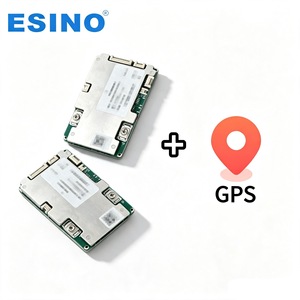
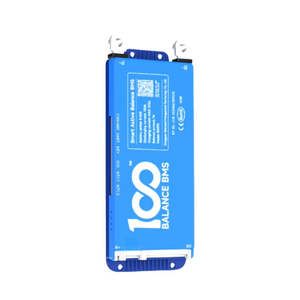
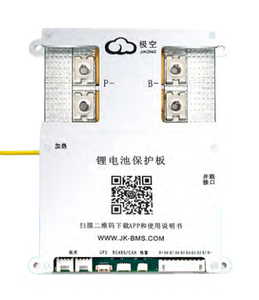
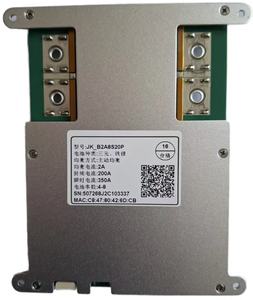
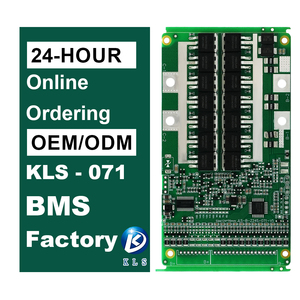
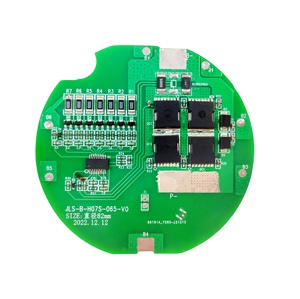
As global OEMs transition to high-capacity LiFePO4 (Lithium Iron Phosphate) and ternary NMC chemistry battery packs, traditional passive dissipation mechanisms are no longer sufficient to solve the complex challenges of voltage drift, thermal management, and pack capacity loss.
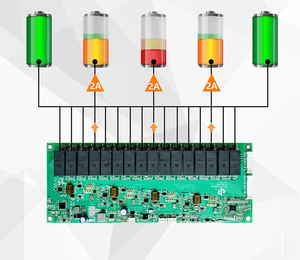
Unlike passive balancing which burns excess energy off as heat across bleed resistors ($P = I^2 R$), active balancing redistributes charge from higher-voltage cells to lower-voltage cells via inductive, capacitive, or transformer-based DC-DC conversion circuits with up to 96% efficiency.
LiFePO4 chemistry exhibits an extremely flat open-circuit voltage (OCV) profile between 30% and 90% State of Charge (SoC). Active balancers utilize high-precision ADC measurement chips ($\pm 1\text{mV}$) to trigger equalization even at micro-voltage differentials where passive systems fail.
Passive balancing only operates during the final CV (Constant Voltage) charging phase. Advanced Chinese active balancers operate dynamically across all battery stages: charge, standby, and deep discharge, preventing single-cell under-voltage shutdowns under heavy load.
| Performance Metric | Passive Resistance BMS | Inductive Active BMS | Capacitive Active BMS | Multi-Transformer Active BMS |
|---|---|---|---|---|
| Energy Balance Method | Thermal Heat Dissipation | Adjacent Inductive Transfer | Switched Capacitor Transfer | Bi-Directional Flyback DC-DC |
| Balancing Current | 30mA – 100mA (0.1A max) | 1A – 5A Continuous | 1A – 2A Dynamic | 5A – 10A High Power |
| Thermal Heat Generation | High ($>65^\circ\text{C}$ enclosure temp) | Negligible ($<35^\circ\text{C}$) | Ultra-Low ($<30^\circ\text{C}$) | Minimal (Active Cooling option) |
| Equalization Efficiency | 0% (Energy wasted entirely) | 88% – 92% | 92% – 96% | 90% – 95% |
| Cell Life Extension | Baseline (1.0x) | 1.25x – 1.30x Extended | 1.30x Extended | 1.40x Maximum Extension |
| Best Application Fit | Small 3C Packs, Laptops | Electric Scooters, E-Bikes (8S-17S) | Home ESS, Telecom 48V (16S) | Grid ESS, EV Swap Stations (32S-64S) |
Global energy transitions, supply chain dynamics, and regulatory compliance standards are shifting procurement paradigms for OEM engineers buying BMS components from China.
BMS procurement is shifting from standalone hardware circuit protection boards to cloud-integrated smart telematics platforms. Top Chinese suppliers now natively integrate CANbus, RS485, Modbus, Bluetooth 5.0, and 4G IoT modules directly onto the active balancing PCBA. Operators can remotely monitor cell voltage standard deviation, State of Charge (SoC), and State of Health (SoH) via MQTT protocols.
Legacy balancers use static voltage thresholds ($\Delta V > 30\text{mV}$). Next-generation active balancers utilize embedded MCU machine-learning models to predict internal cell impedance ($R_i$) drift over 3,000+ duty cycles. The balancer dynamically adjusts transfer current based on temperature, charge rate ($C$-rate), and internal resistance trends to prevent premature cell degradation.
Commercial and Industrial (C&I) energy storage projects demand high-voltage DC bus systems (400V–1000V). Chinese OEMs are leading the release of stacked Master-Slave active balancing topologies (e.g., KLS 64S active BMS modules) capable of balancing long series strings without requiring auxiliary external power supplies.
China’s mature lithium-ion ecosystem provides unmatched advantages in active balancing PCBA development, rapid prototype fabrication, component sourcing security, and automated testing compliance.
Leading manufacturers operate high-speed automated Surface Mount Technology (SMT) lines equipped with 3D AOI (Automated Optical Inspection), SPI (Solder Paste Inspection), and conformal coating stations to guarantee IP67 moisture and dust ingress protection for outdoor installations.
Products undergo stringent quality assurance testing adhering to ISO9001, IATF 16949 automotive standards, CE, FCC, RoHS, and UN38.3 transport safety standard requirements, ensuring seamless customs clearance for export to Europe, North America, and Southeast Asia.
From custom shunt resistor sizing for 200A continuous discharge to localized CANbus protocol flashing (Vicron, Pylontech, SMA, Growatt, Deye inverter compatibility), Chinese suppliers provide agile engineering customization within 2-3 week turnarounds.
In-depth technical answers addressing common engineering inquiries during BMS selection, testing, and batch procurement.